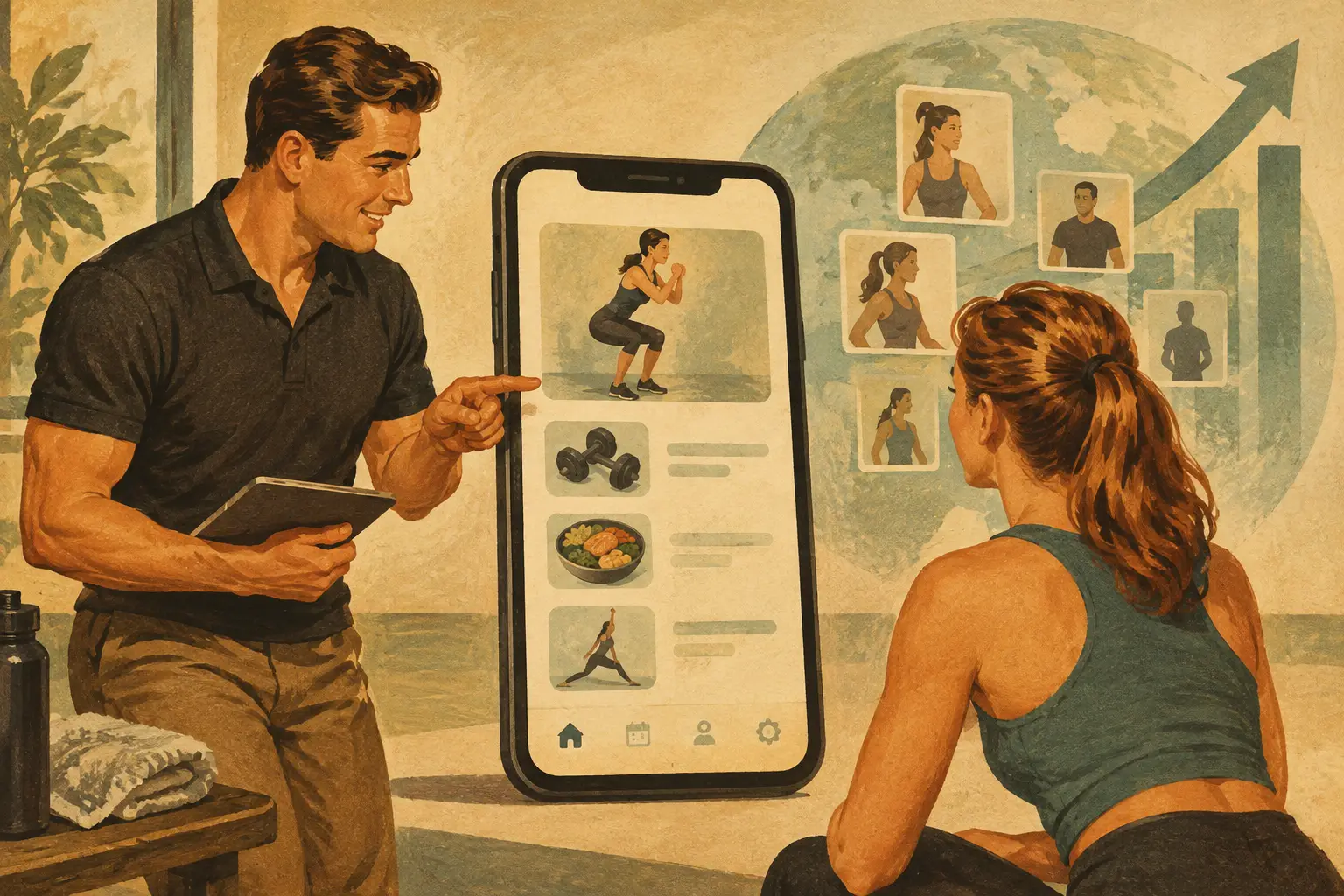
A white label coaching app changes a detail clients notice immediately: whose business they believe they are working with. When an invite email, mobile app, workout plan, meal plan, and progress dashboard all carry your name and visual identity, your service feels like a professional coaching operation rather than a collection of borrowed tools.
That perception matters because online coaching is a recurring relationship. Clients are not only buying a four-week training block or macro targets. They are buying confidence in your process, consistency in communication, and an experience worth renewing. Branding alone will not create those outcomes, but it can reinforce them every day.
What a white label coaching app should actually do
White labeling is often reduced to a logo on an app. That is the visible part, but it is not the standard that matters most. A useful white label platform should give clients a cohesive experience across the moments that drive adherence: receiving a plan, logging workouts, tracking food, completing a check-in, messaging their coach, and reviewing progress.
For a strength coach, that means programming should live next to the data needed to make informed adjustments. For a nutrition coach, meal planning, food logging, recipes, grocery lists, and macros should not feel disconnected from the wider coaching relationship. For hybrid businesses, the client should not have to jump between separate apps just to follow the service they already pay for.
The practical test is simple: when a client asks where to find their next workout, what to eat, or what they need to submit this week, can the answer be one place? If the answer is no, the friction is not only a client experience problem. It becomes an administrative burden for your business.
Why branding affects retention and perceived value
A polished branded environment gives your coaching a home. Instead of sending clients to a generic portal that feels interchangeable, you create a consistent point of contact for your methodology. Your colors, logo, and custom subdomain are not cosmetic extras when they make each interaction feel intentional.
This is particularly valuable as your roster grows. A client who receives personal attention may overlook a few scattered systems. A client in a larger roster will judge the quality of your operation through the reliability of the experience around them. Clear plans, easy check-ins, timely responses, and visible progress all signal that your business has a system behind it.
There is a trade-off. A fully branded client app should support your delivery, not become a reason to over-focus on design while underinvesting in coaching quality. The strongest brand experience is built on useful programming, practical nutrition guidance, and decisions that respond to client data. Visual consistency makes that value easier to recognize.
Training and nutrition belong in the same client experience
Many coaching workflows break apart at the exact point where clients need clarity. Training is delivered in one place, nutrition is handled in another, and weekly feedback arrives through a form or inbox. The coach then becomes the human bridge between disconnected systems.
That model can work for a small number of clients, especially if your service is narrowly focused. But it creates avoidable friction when you coach body composition, performance, lifestyle habits, or physique outcomes. Clients do not experience training and nutrition as separate businesses. Their recovery, energy intake, exercise performance, bodyweight trends, and adherence influence one another.
An integrated platform lets you build programs and meal plans around the same coaching objective. A client can view prescribed sessions, track meals, scan barcodes, use recipes, monitor real-time macros, and access an auto-generated grocery list without leaving the environment where they report progress. That reduces the number of reminders you need to send and makes it easier to spot where adherence is slipping.
For example, low training compliance may be a programming issue, a scheduling issue, or a recovery issue. If nutrition logs and check-in responses are separated from the training plan, identifying the pattern takes longer. If those inputs sit together, the coach can make a faster, better-informed decision.
Automation should protect personalization, not replace it
The fear around automation is reasonable. Generic automation can make a high-ticket coaching service feel generic. But the right use of automation is not about removing the coach from the process. It is about removing repetitive tasks that do not require a coach's judgment.
Consider weekly check-ins. Reading every response, reviewing compliance, comparing trend data, and identifying concerns takes time. A system that summarizes wins, risks, and suggested adjustments gives you a useful starting point. You still decide what matters, how to communicate it, and whether an adjustment fits the client's context.
The same principle applies to training progression. RIR-based load adjustments and automatic deload prompts can make an evidence-based approach easier to deliver consistently. Research from Eric Helms, Mike Zourdos, and Brad Schoenfeld has helped shape the practical conversation around proximity to failure, volume, fatigue, and individual response. Software cannot diagnose every training problem, but it can surface patterns before a coach misses them in a busy week.
Automation earns its place when it produces more time for coaching conversations, program quality, and client retention. It becomes a problem when it creates changes no coach reviews or sends messages that sound detached from the client's situation.
Choosing the right white label coaching app
The right platform depends on your offer and your operating model. A nutrition-only practitioner may prioritize food databases, meal plans, recipe tools, macro tracking, and easy client accountability. A performance coach may put program design, exercise delivery, compliance analytics, and autoregulation first. A growing hybrid business needs both without forcing clients into separate subscriptions and separate logins.
Before committing, evaluate whether the platform handles these four operational requirements:
- Brand control across the app, invite emails, and client-facing communication
- Training design and nutrition delivery within one connected workflow
- Check-ins, messaging, compliance data, and progress visibility for active coaching decisions
- Pricing that remains predictable as your client roster grows
The last point is easy to underestimate. A tool that looks affordable at five clients can become an expense you resent at 50 if every additional client triggers another fee. Flat-rate tiers make it easier to forecast margins and grow without treating new business as a software cost problem.
Also consider the client side, not just the coach dashboard. Native iOS and Android access, mobile web availability, and step syncing through Apple Health and Health Connect can make daily engagement more practical. The best features are the ones clients will actually use between check-ins.
Building a branded workflow that clients follow
A white label platform works best when it supports a clear coaching rhythm. Start the relationship with a branded invite and a straightforward onboarding sequence. Give clients their first training block, nutrition targets or meal plan, and an explanation of what completion looks like in the first week.
From there, use the app to create predictable touchpoints. Clients log sessions and meals during the week, complete a structured check-in on schedule, and receive feedback that connects their behavior to the next action. If adherence drops, address the obstacle before changing the entire plan. If fatigue is rising, review training performance, sleep, nutrition, and stress before assuming the answer is more effort.
CoachingPortal supports this model by combining fully white-labeled delivery, training programming, meal planning, check-ins, messaging, compliance analytics, and AI-assisted review in one client experience. Its free plan includes all features for up to three clients with no card required, while higher tiers support larger rosters without per-client overage fees.
The goal is not to make your coaching feel automated. It is to make the operational parts of your service reliable enough that clients experience more of your expertise and less of your administrative friction.
A branded app will not save a weak offer, but a well-run white label coaching app can make a strong offer easier to understand, easier to follow, and much harder to replace.