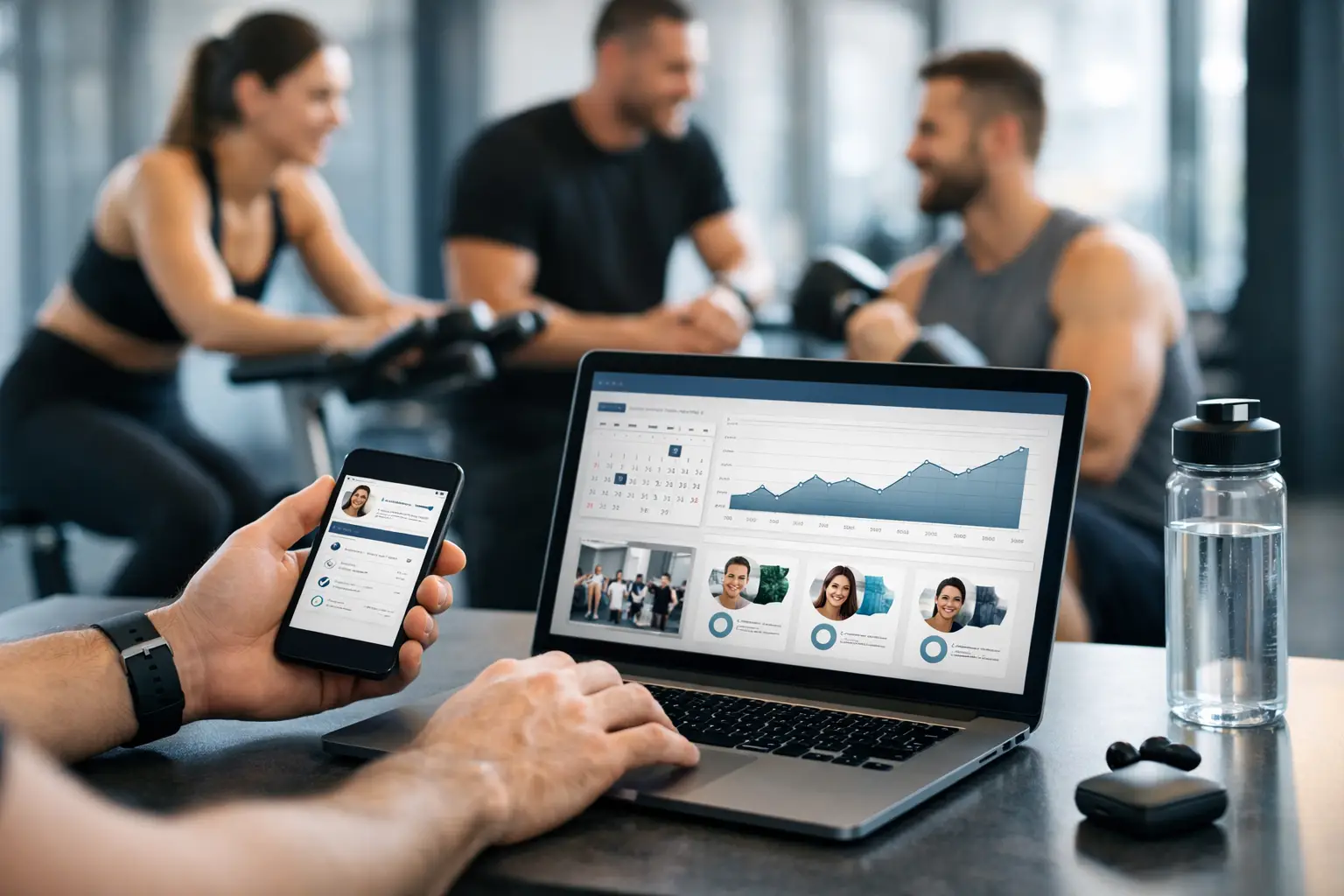
A coach with 30 clients can still hold the whole business together with memory, spreadsheets, and a few late-night check-ins. A coach with 80 clients usually can’t. That’s where fitness client management software stops being a nice-to-have and becomes core infrastructure.
If your delivery lives across Google Sheets, a workout app, a meal plan PDF, text messages, and a form builder, you are paying for that fragmentation every day. You pay in slower response times, inconsistent client follow-through, preventable churn, and hours lost to admin. More importantly, your clients feel the gaps. They notice when check-ins are messy, training progress is hard to track, or nutrition guidance changes depending on where the conversation happened.
What fitness client management software should actually solve
Good software should do more than store client notes. It should reduce coaching friction while improving the quality of delivery. That means bringing programming, nutrition, habits, communication, and progress analysis into one operating system.
For a serious coach, the goal is not to automate the relationship. The goal is to automate the repetitive work around the relationship so you can coach at a higher level. That distinction matters. If your system saves time but weakens personalization, it is not helping your business long term.
The best fitness client management software creates structure on both sides. Coaches get cleaner workflows, better visibility, and repeatable service standards. Clients get a more professional experience with clear expectations, easier adherence, and faster feedback loops.
The real cost of disconnected tools
Most coaching businesses do not hit a wall because demand disappears. They hit a wall because operations get messy. Every extra app adds another place for information to get lost, duplicated, or delayed.
A common example is weekly check-ins. A client submits body weight in one form, progress photos in another folder, training notes in a chat thread, and nutrition adherence in a separate app. Now the coach has to assemble the full picture manually before making decisions. That process is slow, and slow decisions usually mean weaker client momentum.
There is also a consistency problem. When workflows depend on the coach remembering every step, service quality can vary week to week. Some clients get detailed reviews. Others get shorter replies because the coach is overloaded. That inconsistency affects retention more than most coaches realize.
Consolidation matters because coaching decisions are connected. Training progression should reflect recovery, compliance, body composition trends, and nutrition adherence. Software that keeps those inputs in one place makes better coaching possible, not just faster administration.
The features that matter most for coaching results
Workout delivery is still the anchor for many businesses, but programming alone is not enough. A useful platform should support progressive overload, exercise substitutions, progression rules, and a client-friendly training experience on mobile. If a program looks great on the coach side but is confusing on the client side, adherence drops.
Nutrition tools are just as important for physique, performance, and body composition outcomes. Coaches need more than static meal plans. They need macro management, food guidance, adjustment logic, and a practical way to monitor adherence without turning every client into a full-time tracker. Depending on your niche, some clients need precision while others need structure with flexibility. Your software should support both.
Check-ins are where high-level coaching happens. Strong fitness client management software should make it easy to collect subjective and objective data together: scale trends, photos, measurements, sleep, hunger, energy, training performance, digestion, and compliance. Just collecting the data is not enough. The review process also needs to be fast enough that coaches actually use the information consistently.
Messaging matters, but it should support the system rather than replace it. When all coaching happens in chat, important context disappears into endless threads. A better setup gives clients a direct communication channel while keeping decision-making tied to structured data and scheduled review points.
Analytics and habit tracking are often underrated. Clients do better when they can see momentum, not just hear about it. Coaches also make better calls when they can spot trends early instead of reacting after a plateau has already become a problem.
Automation is valuable when it protects coaching quality
Some coaches hear the word automation and assume it means generic coaching. Usually the opposite is true. Smart automation protects quality by making the basics reliable.
For example, automated reminders can improve check-in completion. Compliance scoring can help a coach identify which clients need a behavior-focused intervention before changing calories or training volume. Progression management can reduce programming errors and make updates more consistent across a growing roster.
AI support also has a place, if it is built around real coaching workflows. The standard should be practical utility, not novelty. Can it speed up exercise programming, help interpret check-in patterns, suggest food options that fit targets, or reduce repetitive admin without weakening the coach’s judgment? If yes, it saves time where time is usually wasted.
This is where platforms built for coaches tend to outperform general business software. CoachingPortal, for example, combines programming, nutrition, check-ins, messaging, analytics, and AI-assisted workflow support in one system. That matters because most scaling problems in coaching come from context switching, not from a lack of effort.
What to look for before you switch
The right platform depends on your delivery model. A 1:1 online physique coach has different needs than a hybrid personal trainer with a local gym roster. A nutrition-first coach may care more about meal planning depth than advanced training logic. But there are still a few standards that should not be optional.
First, the software should fit your method. If your coaching process is evidence-based and data-driven, the platform should make that easier rather than forcing a generic workflow. Second, it should support scale without making the client experience feel colder. White-label branding, a polished mobile experience, and clear communication structure all help maintain perceived value as your roster grows.
Third, look closely at setup and daily use. Some platforms promise everything and become bloated in practice. The question is not whether a feature exists. The question is whether it reduces work every week. If a tool takes 20 clicks to do what you currently handle in five, it is not helping.
Fourth, consider pricing relative to client volume. A subscription that looks cheap at 20 clients can become expensive at 100. On the other hand, paying more for a system that saves 8 to 10 hours per week is often the better business decision. Time recovered can be used to improve service, increase capacity, or both.
Why better systems improve retention
Retention is usually treated as a motivation problem. Often it is a systems problem. Clients stay longer when the coaching experience feels organized, responsive, and specific to them.
When software supports fast feedback, visible progress, and daily engagement, clients are more likely to stay compliant through the boring middle of the process. That matters because long-term results rarely come from perfect weeks. They come from enough consistency over enough time.
A structured platform also increases trust. Clients do not always understand the science behind every coaching decision, but they do recognize professionalism. They can tell when their training updates are thoughtful, when nutrition changes reflect actual data, and when the process feels intentional instead of improvised.
That trust has direct business value. Better retention increases lifetime value, stabilizes revenue, and reduces the pressure to constantly replace churned clients. For a growing coaching business, that is often a more meaningful lever than chasing more leads.
The best software is the one that lets you coach more and manage less
There is no perfect tool for every coach. Some need deeper nutrition systems. Others need stronger workout architecture or better team visibility. But the direction is clear. If your current setup creates duplicate work, slows decision-making, and fragments the client journey, it is limiting both your results and your growth.
Fitness client management software should give you one place to deliver coaching with consistency, speed, and professionalism. It should help you make better decisions, not just store information. And it should create a client experience that feels high-touch even as the business scales.
If you want to coach at a higher level, start by fixing the system behind the coaching. That is usually where the next stage of growth actually begins.